
In a world that is rearming but cannot ignore the energy transition, measuring IT sustainability is not a cost, it is an investment that lowers the cost of credit. In this article, we explain how IT impacts have entered bank ratings and what concrete tools allow measurement to be transformed into financial leverage.
With wars looming and resilience becoming a strategic priority, IT investments have shifted toward national security, strategic autonomy, and business continuity. In this context, many think that IT sustainability is a luxury we can no longer afford. In reality, it weighs more heavily than ever before because it has become a direct factor in bank risk ratings.
Not as an ideal, but as a measure of how well a company can manage its environmental risks—particularly those related to IT, such as data center and cloud energy consumption, indirect emissions from digital services, and hardware lifecycle management.
Banks are increasingly looking at the ability to control the trade-off between cost and CO₂, especially in technology-intensive areas. Those who do not measure these impacts expose their companies to uncontrolled transition risks: increased carbon taxes, the obsolescence of inefficient infrastructure, loss of access to “green” capital, and exclusion from tenders with ESG criteria. Those who measure and manage them demonstrate control, discipline, and financial reliability—exactly what banks are looking for to reduce perceived risk and improve credit conditions.
n recent years, sustainability has moved beyond the scope of corporate social responsibility to become part of risk management and credit assessment. This change is not ideological but structural, and is driven by three factors:
Rating agencies (S&P, Moody's, Fitch) and banks have integrated ESG factors into their risk assessment models. Not out of idealism, but because climate events, energy transition regulations, and reputational risks have a material impact on balance sheets. A 2025 study of 106 listed European banks confirmed that environmental factors have a significant influence on the credit ratings of all three major agencies, demonstrating that ESG is now a structural part of risk assessment methodologies.
A company with high carbon exposure and poor adaptability becomes objectively riskier to finance: operating costs exposed to energy volatility, infrastructure at risk of obsolescence, competitiveness threatened. For banks, this means greater risk and therefore higher spreads.
With the CSRD (Corporate Sustainability Reporting Directive) and EU taxonomy, reporting on environmental impacts has become mandatory for thousands of European companies. Those who do not measure and report this data find themselves off the radar of institutional investors: pension funds, asset managers, and central banks with ESG mandates cannot invest in companies without credible disclosure.
The result? Higher spreads, limited access to capital, exclusion from green bonds and sustainability-linked loans, loans whose interest rate is reduced when verifiable ESG targets are achieved.
Banks distinguish between physical risks (damage from climate events) and transition risks (asset obsolescence, rising regulatory costs, loss of competitiveness in the transition to a low-carbon economy). According to the Institute for Energy Economics and Financial Analysis (IEEFA), rating agencies' ESG scores serve to make more transparent how these risks affect credit ratings, and the pressure towards net zero is already lowering many existing ratings.
A company that demonstrates its ability to measure, predict, and mitigate these risks reduces its risk profile and obtains better credit terms. Those that ignore them accumulate exposures that will translate into concrete costs.
While IT sustainability has become a credit rating parameter, measuring it remains a complex challenge. CSRD requires reporting of IT emissions in two areas—Scope 2 (internal data center energy consumption) and Scope 3 (emissions from cloud, hardware, and e-waste)—with data measured, verified, and published according to uniform standards.
But modern IT infrastructure—hybrid, distributed, multi-cloud—makes it difficult to achieve consistent visibility. Internal data centers need granular tools to track the energy consumption, emissions, and lifecycle of every single physical asset: obsolete servers, underutilized storage, and energy-intensive network equipment continue to operate unchecked. Many companies only see the total bill without knowing which hardware generates the most CO₂ or is nearing end-of-life.
The situation is worse in the cloud: AWS, Azure, and Google Cloud use different metrics, proprietary taxonomies, and incomparable reports. The CFO sees fragmented costs, the sustainability manager does not aggregate emissions, and banks receive inconsistent data.
Even when data exists, there is a lack of capacity to manage the trade-off between cost and CO₂. Let's take a concrete case that is frequently repeated in European companies: the choice of cloud region for a new deployment.
For example, an AWS region in Germany could cost €9,000 per month and generate 11 tons of CO₂. A region in France could cost €11,000 per month but generate only 9 tons of CO₂, thanks to its predominantly nuclear and renewable energy mix. Without integrated tools that show both metrics, the company chooses Germany to save €2,000 per month. A seemingly rational decision, but one that accumulates transition risks: when higher carbon taxes arrive (already planned in the European ETS), when CSRD audits become more stringent, when the conditions of sustainability-linked loans require more ambitious targets, that initial saving will turn into urgent migration costs, worsening ESG ratings, and higher bank spreads.
Another common example: an oversized cloud instance could cost €5,000 per month, generate 6 tons of CO₂, and operate at 30% CPU utilization. By optimizing it (rightsizing), it could be reduced to €3,500 per month and 4 tons of CO₂, while maintaining the same performance. But without joint visibility on cost and emissions, this opportunity remains invisible.
Without tools that integrate FinOps (cloud cost governance) and GreenOps (IT carbon footprint measurement and reduction), the trade-off remains ungoverned, and for banks, unmeasured risk means greater risk.
According to the Flexera 2026 IT Priorities Report, 94% of IT leaders consider IT sustainability a growing priority, while 87% recognize that their organization needs to improve its sustainability practices. This gap between awareness and operational capacity highlights a structural problem: sustainability teams need granular, easily accessible data, but this data is often scattered without common tools to aggregate and interpret it.
WEGG – The Impact Factory addresses this problem with an approach that integrates technology and organizational culture.
Flexera, a vendor recognized for its Technology Intelligence, offering a 360° view of the consumption of the entire IT infrastructure thanks to two advanced technologies: - IT Visibility for on-premises
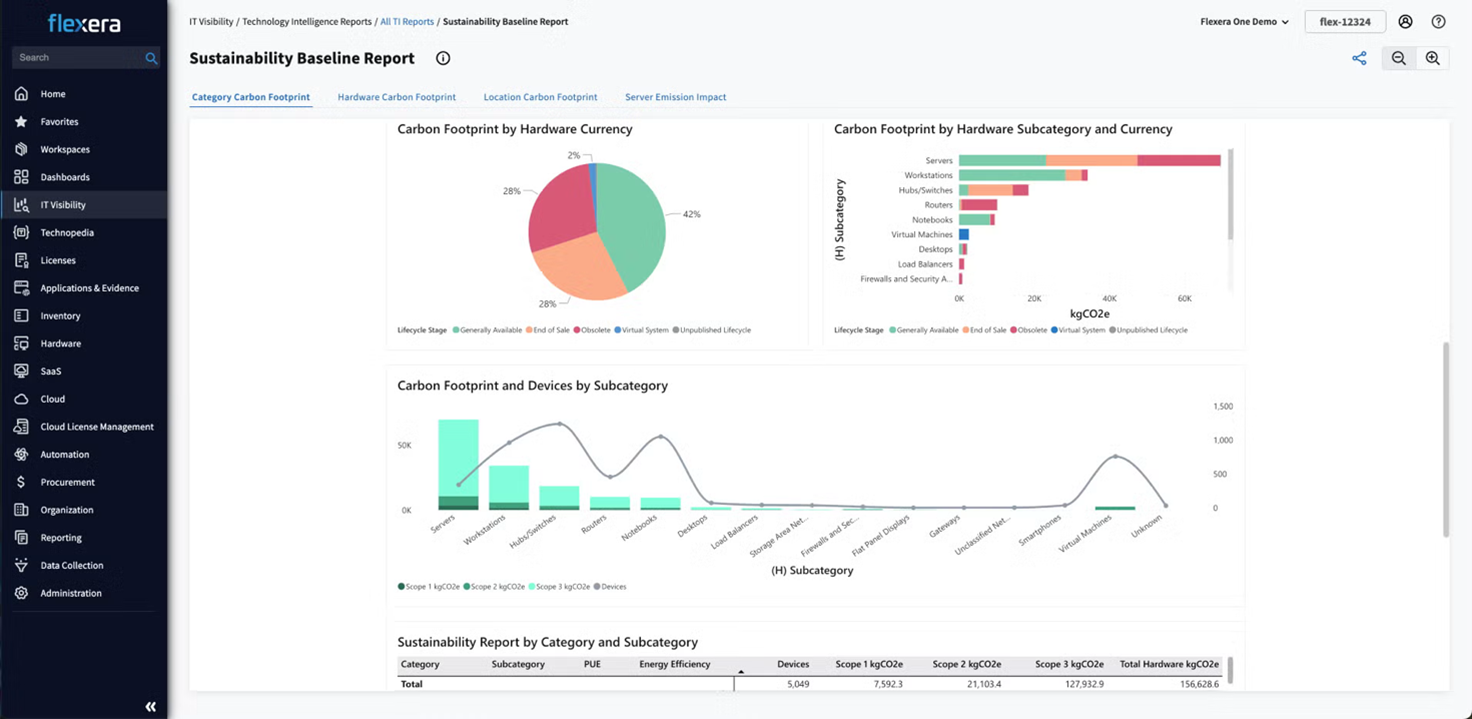
ITV provides a complete and automated inventory of all physical and virtual IT assets in the on-premise infrastructure: servers, storage, network devices, with details on configurations, energy consumption, lifecycle, and geographic distribution. Thanks to its integration with Technopedia—a database containing technical and environmental specifications for millions of hardware products—IT Visibility calculates a sustainability baseline, quantifying the carbon footprint of on-premise assets, identifying the most energy-intensive ones, and providing the granular data needed for CSRD reporting and to demonstrate control over impacts to banks.
A concrete example: a 10-year-old server typically consumes €500 per month in electricity, generates 3 tons of CO₂, and experiences frequent downtime that impacts productivity. Replacing it with modern energy-efficient hardware requires an investment of €1,200 in amortized capex, but reduces consumption to €200 per month and emissions to 1 ton of CO₂. The ROI? Four months later, you get continuous net savings plus a drastic reduction in the risk of obsolescence. But without IT Visibility, that server remains operational, burning resources and emissions, invisible in CSRD reports and bank assessments.
- Cloud Cost Optimization for multi-cloud
CCO aggregates and normalizes spending and consumption data from all major cloud providers—AWS, Azure, Google Cloud—into a single, comparable framework. It not only tracks costs, but also calculates the emissions associated with each cloud service, providing granular visibility by workload, project, and business unit. This allows you to identify opportunities for both economic and environmental optimization: low-carbon regions, instance rightsizing, storage optimization.
But technology alone is not enough: you need structured data collection processes and, especially for the cloud, a FinOps culture that spans the entire company. FinOps is not only used to optimize operating costs, but also to support strategic decisions: choosing the most sustainable regions, planning commitments (reserved instances, savings plans), and balancing performance and environmental impact.
WEGG actively promotes this culture by building a cross-functional FinOps Center of Excellence (CoE) that involves IT, Engineering, finance, sustainability, and business units. By implementing appropriate technologies and processes, all key figures—including the sustainability manager and CFO—gain shared visibility into costs and emissions, enabling data-driven decisions that reduce the risk perceived by banks and improve access to capital.
In summary: in a world that is rearming but cannot ignore the energy transition, measuring IT sustainability is not a cost, it is an investment that lowers the cost of credit. Those who do so today build resilience, access privileged capital, and demonstrate risk control. Those who ignore it accumulate invisible exposures that tomorrow will translate into higher spreads, exclusion from tenders, and missed opportunities. Measurement transforms invisible emissions into data that banks price, hidden risks into metrics that investors evaluate. That's why, even in times of war, sustainability continues to pay off, and not just for ethical reasons.
Insights

OUR OFFICES
OUR OFFICES
PADUA
Via Arnaldo Fusinato 42, 35137
MILAN
Viale Enrico Forlanini 23, 20134
ROME
Viale Giorgio Ribotta 11, 00144
Copyright © 2025 WEGG S.r.l. • P.I 03447430285 • C.F. 02371140233 • REA 311023
Azienda Certificata ISO 9001:2015 – ITA / ISO 9001:2015 – EN


